Respiratory Disease CRO Services
Accelerating Respiratory Development Through Endpoint Quality, ATS/ERS-Aligned Standards, Deep Pulmonary Expertise, & Operational Precision
Respiratory programs succeed when measurement quality matches enrollment performance. With standardized pulmonary testing, fit-for-purpose endpoints, and experienced sites, Worldwide delivers reliable data, faster enrollment, and predictable execution.
Respiratory Expertise Tailored to Your Study Needs
Specialized Respiratory Delivery Across Chronic, Rare & Mucus –Related Respiratory Indications including ILD, IPF, COPD & Asthma
We combine deep pulmonary expertise, established site networks, and proven capability in endpoint acquisition.
Precision Endpoint Measurement & Sustained Data Quality
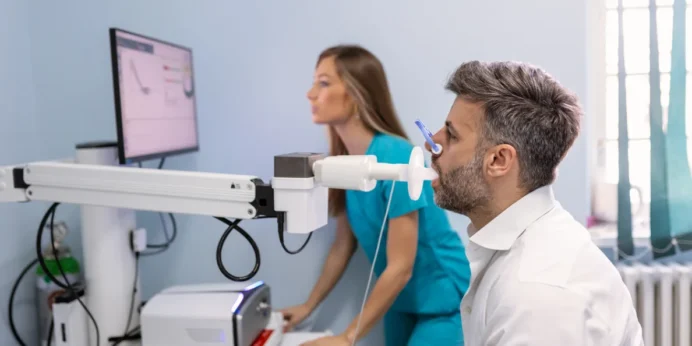
Pulmonary function testing performed and monitored to ATS/ERS 2019 standards across every site and every visit, protecting endpoint integrity and the probability of detecting a meaningful treatment effect.
Deep Pulmonary & Endpoint Scientific Leadership
Turning respiratory endpoint science into actionable development strategy through indication-specific endpoint selection, QoL and psychometric instrument development, and regulatory insight that reduces uncertainty and strengthens decision-making.
Delivering Complex Programs With Confidence
Bringing together multi-protocol program delivery, specialty modalities including RNAi and gene therapy, and data-driven site selection in competitive patient populations to enable efficient delivery, mitigate program risk and accelerate decisions.
The Whole Autoimmune Spectrum, Covered
From First-in-Human to Pivotal Phase III, Across the Full Respiratory Spectrum & Specialty Modalities
Fibrotic & Interstitial
- Idiopathic Pulmonary Fibrosis (IPF)
- Interstitial Lung Disease (ILD)
Obstructive & Inflammatory Airway
- Chronic Obstructive Pulmonary Disease (COPD)
- Asthma
Genetic & Specialty Modality
- Cystic Fibrosis
- RNAi
- Gene Therapy

Services & Capabilities
Respiratory CRO Services Across Every Phase
- Expert PFT Quality Oversight
- Deep Experience in IPF & ILD Trial Delivery
- COPD & Asthma Program Delivery Expertise
- Milestone-Driven Delivery
- Endpoint Strategy & Design
- ATS/ERS Spirometry Training
- Clario Partnership Integration
- QoL & Psychometric Instrument Design
- Specialty Modality Respiratory Programs

Pulmonary Function Testing Quality
ATS/ERS 2019-aligned training and continuous data surveillance delivering 94% acceptable PFT quality across global sites and phases.

IPF & ILD Trial Delivery
Worldwide delivers IPF and ILD programs from Phase I through pivotal Phase III, with site strategy and endpoint oversight built around each indication’s specific demands.

COPD & Asthma Program Support
Global multi-protocol delivery at scale, including a four-study asthma program spanning 995 sites in 31 countries with more than 2,000 participants enrolled, with endpoint strategy and site networks scaled to indication-specific populations.

Milestone-Driven Operational Delivery
Reverse-planned from your regulatory or fundraising milestone, with per-patient data cleaning and vendor coordination structured around the date that cannot move.

Specialty Modality Respiratory Programs
RNAi, gene therapy, and emerging modality programs requiring specialized site networks and complex respiratory endpoint management.
Why Worldwide for Respiratory Trials
Reduced Risk for Milestones That Hold
Sustained Endpoint Quality Above the Industry Benchmark
Acceptable PFT quality runs at 94% against a 91% industry benchmark, sustained across global sites through ATS/ERS 2019-aligned training, real-time data surveillance and continuous site support.
Dedicated Site-Level Oversight That Protects Enrollment
A Clinical Site Liaison sits at site level for daily support and weekly leadership check-ins throughout the program, so enrollment risk is visible and addressed while it is still recoverable.
Predictable, Confident Delivery to Plan
On a Phase II IPF study competing against multiple active trials for the same treatment-naive population, enrollment targets were surpassed, the interim analysis was delivered on time, and the primary plus all secondary endpoints were met.
Specialized Respiratory Leadership
Meet Our Respiratory Experts
Our respiratory scientists publish in the indications they deliver, including the April 2026 white paper Beyond the Lungs on integrating QoL and psychometric instruments into IPF trial protocols. That gives us an accessible network of investigators and KOLs, and an early read on where regulatory expectations for respiratory endpoints are moving.





Partnership & Approach
Senior Respiratory Partnership, Built Around Your Milestone Date
You will work with the same scientific, medical and operational leads from bid defense to database lock, with a Clinical Site Liaison at site level providing daily support and weekly leadership check-ins. Vendor oversight runs through a single point of accountability, and delivery is reverse-planned from the milestone date rather than from the protocol.
What Worldwide’s Respiratory Programs Have Delivered
Eight IPF studies, a four-study global asthma program across 31 countries, and pulmonary function quality held above the industry benchmark at every site.
94%
Acceptable PFT Quality Against a 91% Industry Benchmark
Three points above industry standard, maintained across global sites through ATS/ERS-aligned training and continuous Clario oversight.

390+
Sites Activated
915+
Patients Enrolled
Across 8+ IPF studies, with site relationships deep enough to sustain enrollment momentum across IPF patient populations.

170
Sites Activated Inside 90 Days, Across a Global, Four-Study Asthma Program
A Global Phase II IPF surpassed enrollment targets and met primary plus all secondary endpoints in a study competing against multiple active studies for the same treatment-naive patient population.
995 sites and more than 2,000 participants enrolled across 31 countries in Asia Pacific, Europe, Latin America and North America.

Frequently Asked Questions
Your Questions Answered
We have answered the questions sponsors ask most often about respiratory programs. If yours isn’t here, our respiratory team is happy to help.
Worldwide delivers programs across IPF, ILD, COPD, asthma, cystic fibrosis, chronic cough, and bronchiectasis, from Phase I through pivotal Phase III, including specialty modality programs in RNAi and gene therapy.
Training is aligned to ATS/ERS 2019 spirometry guidelines, and PFT quality runs at 94% acceptable against the 91% industry benchmark. The strategic partnership with Clario adds equipment quality oversight, real-time data review, and ongoing site coaching throughout every program.
Worldwide reverse-plans from the milestone date rather than from the protocol, runs per-patient data cleaning continuously so the database is not the bottleneck at the end, and coordinates sponsor-managed vendors through a single point of accountability. The effect is that the date sponsors have committed to externally stays the date the program is built around.
Site selection is built around documented IPF track record, with a Clinical Site Liaison providing daily site-level support and weekly leadership check-ins throughout every program. Across 8+ IPF studies, Worldwide has maintained the site relationships needed to keep enrollment moving even when multiple competing studies are targeting the same patient pool.
Worldwide’s respiratory medical and scientific team tracks FDA and EMA guidance closely, including growing regulator interest in QoL and psychometric instruments in IPF programs. The Beyond the Lungs white paper, co-authored by Drew Matheson, reflects that forward-looking thinking and is available as a resource for sponsors designing protocols now.
Portfolio programs fail on duplicated effort more often than on any single protocol. On a four-study global asthma program across 31 countries, resourcing was assigned at program level rather than per protocol, internal reviews were run once across the program rather than repeated, and respiratory-specific guideline training was developed by our subject matter experts and delivered to CRAs and site staff. Sites activated faster, protocol deviations fell, and the resourcing plan flexed as protocol activity shifted rather than being rebuilt each time.
Insights
Explore Our Respiratory Insights
See what our respiratory team is observing across active studies, from IPF endpoint design to patient-centered trial strategy.