
Autoimmune CRO Services
Accelerating Development Through Precision Patient Identification, Deep Scientific Insight & Operational Excellence
At Worldwide, we understand that study timelines are won or lost months before site activation. The right eligibility criteria, enrollment-proven sites, and patient-centric protocols are the foundation of predictable delivery. By partnering early to optimize these key drivers, we help sponsors reduce risk, accelerate enrollment, and keep development programs on track.
Why Autoimmune Drug Development Demands Specialized Support
Where Autoimmune Timelines Are Won
We bring together therapeutic expertise in chronic and rare autoimmune diseases, precision diagnostic capabilities and mastery of complex study design to safeguard endpoints to help our partners de-risk development and accelerate decisions
Precision Patient Targeting & Optimized Retention
Diagnostic precision that identifies the right patients, strengthens endpoint integrity, and maximizes the probability of detecting a meaningful treatment effect
Deep Immunology & Biomarker Expertise
Translating biomarker science into precision development strategies through rigorous selection, validation, and stratification approaches that enhance patient enrichment, support complex endpoint assessment, and drive more confident development decisions
Ability to Efficiently Navigate Complex, Global Studies
Bringing together expertise in complex development strategies, innovative therapeutic modalities including cell and gene therapies, and composite endpoint execution with data-driven site and investigator selection and proven regulatory insight to enable efficient delivery, mitigate risk, and accelerate clinical success
The Whole Autoimmune Spectrum, Covered
From First-in-Human to Global Phase III, Across the Autoimmune Spectrum, including Chronic & Rare Indications
GI-Autoimmune & Digestive
- Inflammatory Bowel Disease (IBD)
- Crohn’s Disease
- Ulcerative Colitis (UC)
- Celiac Disease
- Biologic and Biosimilar Programs
- Adaptive Trial Designs for GI-Autoimmune Variability
Rheumatic & Connective Tissue
- Systemic Lupus Erythematosus (SLE/Lupus)
- Psoriasis and Psoriatic Arthritis
- Ankylosing Spondylitis
- Systemic Sclerosis (Scleroderma)
- Pemphigus
- Rheumatoid Arthritis (RA)
Emerging & Complex Autoimmune
- Immuno-Neurology
- Connective Tissue Disorders
- Rare Inflammatory Disease
- Gene and Cell Therapy Modalities
- Complex and Adaptive Designs

Services & Capabilities
What We Do Before Your First Site Opens
- Protocol Design & Feasibility
- Biomarker Eligibility Strategy
- Early Phase Autoimmune Development
- Adaptive Trial Design
- Global Phase II & III Delivery
- Retention & Visit Burden

Protocol Design & Feasibility
Eligibility criteria, biomarker cutoffs and endpoint definitions arrive at site activation already tested against current clinical practice, so feasibility risk surfaces in design rather than in a change order.

Biomarker Eligibility Strategy
Biomarker-enriched eligibility across fecal calprotectin in IBD, anti-dsDNA and complement in lupus, and urinary biomarkers in rare autoimmune indications, designed for endpoint integrity and clean signal detection.

Early Phase Autoimmune Development
Worldwide supports early-phase autoimmune development through scientific and operational expertise and a global network of qualified research partners.

Adaptive Trial Design
Worldwide brings basket trial, umbrella trial, and adaptive design expertise to autoimmune programs where flare timing and disease activity shape randomization and enrollment strategy.

Global Phase II & III Delivery
53 of our 75 autoimmune studies over the past five years were global Phase II or III, across IBD, rheumatology, lupus and rare systemic indications.

Retention & Visit Burden
Long maintenance periods, frequent visits and invasive assessments make retention the second half of the enrollment challenge. Visit design, ePRO flexibility and home health for off-site labs are built into the protocol from the start.
Why Worldwide for Autoimmune Trials
Reduced Risk for Accelerated Timelines
Protocol Precision That Reduces Screen Failure
On a Phase II autoimmune study, senior scientific and medical reviewers built a registry of trial-ready eligible patients that delivered a 7 percentage point reduction in global screen failure rate.
Regulatory-Grade Endpoint Quality
On a global Phase III rheumatoid arthritis program, submission-ready endpoint data was accepted by the FDA, PMDA and EMA, with eCOA go-live accelerated by around two months across 5,000 endpoint visits.
Predictable, Confident Delivery to Plan
Across three consecutive global Phase II immunology and inflammation programs, including one spanning 20 countries and 102 sites, last patient in was delivered ahead of schedule every time.
Specialized Autoimmune Leadership
Meet Our Autoimmune Experts
Our autoimmune scientists publish in the indications they deliver. That gives us an accessible network of investigators and KOLs, and an early read on where endpoint expectations are moving, including the April 2026 white paper on biomarker precision and recruitment.



Attila Timar-Peregrin, MD, PhD
Executive Director, Medical Affairs & Therapeutic Area Lead, Digestive Diseases

Partnership & Approach
Senior Autoimmune Partnership, Built Around Your Program
You will work with the same scientific, medical and operational leads from bid defense to database lock. CRA turnover across our immunology and inflammation programs runs at 9.5% against an industry average closer to 25%, and our structure is flat enough that when a decision needs making, the people who can make it are already on your program. Sponsors who run repeat programs with us do not restart the relationship each time.
What Worldwide’s Autoimmune Programs Have Delivered
75 autoimmune studies over the past five years, across every phase, and a record of holding the dates sponsors planned around.
#1 — Highest-Rated Phase II/III CRO, Second Consecutive Year
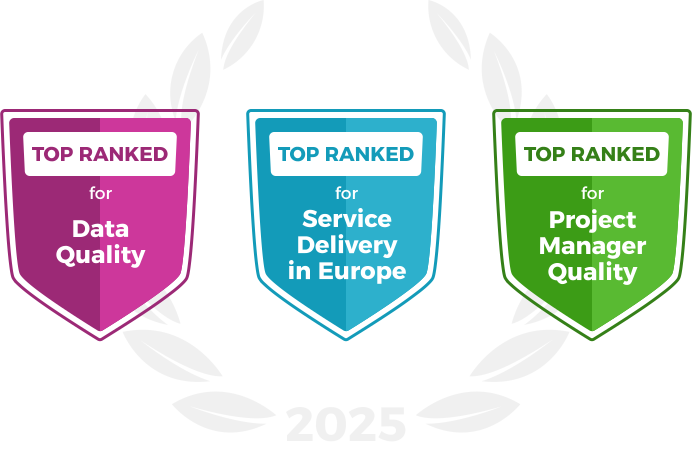
Ranked by the Industry Standard Research report, with Top Ranked badges for Data Quality, Service Delivery in Europe, and Project Manager Quality
90%+
Patient Retention on a
Global Phase III Program
Against an initial 75% target, across a five-country plaque psoriasis switching study
“The top reasons why we selected Worldwide is that they showed they had the experience and how the team interacted together, all of that collaboration spirit.”

VP Clinical Operations, Large Pharmaceutical Sponsor
3 Months
Final Protocol to First Patient Screened,
Across 18 Countries
More than 50% faster than industry average, on a global Phase II Crohn’s disease program
“I honestly felt like the RFP process with Worldwide Clinical Trials was the best experience that I’ve ever had with any CRO vendor going through the proposal process. Maybe that’s because their BD rep was just that responsive and that easy to work with.”
Director of Clinical Operations, Small Biopharma Customer
Frequently Asked Questions
Your Questions Answered
We have answered the questions sponsors ask most often about autoimmune programs. If yours isn’t here, our autoimmune team is happy to help.
Worldwide delivers programs across three indication groups: GI-autoimmune and digestive conditions including IBD, Crohn’s disease, and ulcerative colitis; rheumatic and connective tissue conditions including rheumatoid arthritis, lupus, psoriasis, and systemic sclerosis; and emerging and complex autoimmune conditions including atopic dermatitis, immuno-neurology, rare inflammatory disease, and gene and cell therapy modalities.
Screen failure starts at protocol design, not at the site. Before any site is activated, our senior scientific and medical reviewers test eligibility logic, biomarker cutoffs and endpoint definitions against how patients actually present in current practice. In IBD that means calprotectin and CRP thresholds, and confirming that central and local endoscopy reads agree. It is detail that site feasibility surveys rarely cover, and it pays back directly in screening yield.
Autoimmune protocols ask a great deal of patients: frequent visits, invasive assessments, and long maintenance periods during which many of them feel well. We plan for that at design stage rather than at rescue stage, with flexible ePRO capture, home health for off-site labs, and visit windows built against real travel and work constraints. On two global Phase III plaque psoriasis programs, retention held at 86% and above 90%, the second against an initial 75% target.
Biomarker eligibility is set against how patients present in the clinic, not against an idealized profile. Where the thresholds sit determines who screens in, which is why we test them before activation rather than after. The April 2026 white paper, Optimizing Recruitment and Biomarker Precision in Autoimmune and Rare Autoimmune Trials, sets out the approach in full.
Composite autoimmune endpoints (DAS28-CRP, ACR20/50/70, Mayo, SLEDAI) depend on rater consistency across sites and across time. We train to a single standard, then watch for rater drift through continuous data surveillance and correct it early rather than at database lock.
Insights