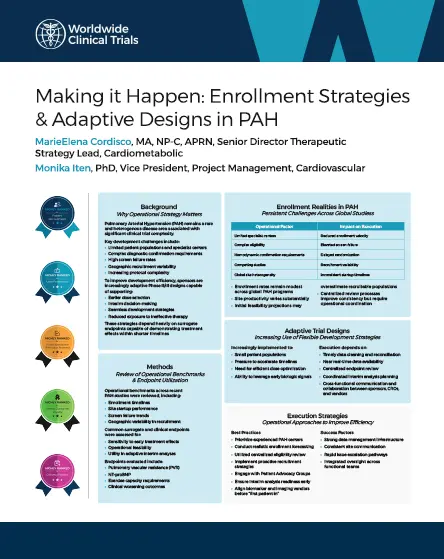
Pulmonary arterial hypertension (PAH) is a rare and heterogeneous disease that presents significant complexity in clinical trial design and execution. As sponsors seek to accelerate development timelines, adaptive Phase II/III designs are gaining traction for their ability to support earlier dose selection, interim decision-making, seamless development strategies, and reduced patient exposure to ineffective therapy. Realizing the full potential of these approaches depends on identifying surrogate endpoints that can demonstrate treatment effects within shorter windows, as well as on disciplined management of enrollment realities, site variability, hemodynamic data, and biomarkers.
Read our poster for a comprehensive overview of operational benchmarks, endpoint strategies, and execution best practices to help sponsors navigate PAH trials with greater confidence and efficiency.
Authors: