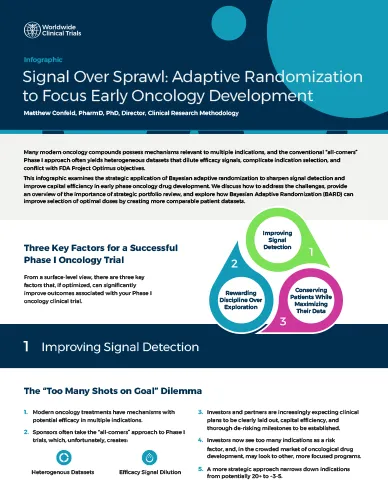
In early-phase oncology drug development, the pressure to demonstrate value quickly has never been greater. Yet many sponsors still rely on broad “all-comers” trial designs that generate heterogeneous datasets, dilute efficacy signals, and create downstream complications under evolving regulatory frameworks like FDA Project Optimus. The result is wasted capital, inconclusive data, and mounting pressure from investors and partners who expect clearly defined development plans with rigorous de-risking milestones. Worldwide Clinical Trials brings a more strategic, signal-focused approach to early oncology trials — one that narrows the indication landscape and deploys adaptive statistical methodology to maximize the value of every patient enrolled.
Read our infographic, where we explore how Bayesian Adaptive Randomization (BARD) can sharpen signal detection and improve capital efficiency in early-phase oncology development, including:
- Why the “all-comers” approach creates heterogeneous datasets, dilutes efficacy signals, and complicates indication selection and FDA Project Optimus compliance
- How strategic portfolio review and indication prioritization can narrow a development program from 20+ potential indications to a focused set of 3–5 high-probability candidates
- How BARD and the Bayesian Optimized Interval (BOIN) methodology enable adaptive, capital-efficient trial designs that generate cleaner, more comparable datasets while minimizing participant burden