New Position Paper
Why Clinical Trials Fail: The Hidden Cost of Under-Specified Trial Design
Biology decides whether a therapy works. Your development design decides whether you’ll understand why.
A perspective from Panteli Theocharous, Ph.D., FRCPath
Chief Therapeutics and Clinical Strategy Officer, President of Europe
Explore how decisions made early in development can determine whether you’ll understand why a therapy succeeds or fails.
When a clinical trial fails, retrospective evaluation often points to execution: the CRO, the sites, and the data. But clinical trial failure can begin much earlier, with clinical trial design decisions that leave important questions unanswered.
Those open questions add up to what Dr. Panteli Theocharous calls uncertainty debt. It is owed at the readout, when your program has the least room to change course.
This paper shows where that debt builds up and how to reduce it before your next decision point.
What's Inside
- Why clinical trials fail, and why the cause is often misdiagnosed
- What uncertainty debt is, and how it differs from biological risk you can't remove
- How uncertainty gets more expensive as your options narrow
- How vagueness changes from small molecules to cell and gene therapy
- A framework for scoring uncertainty before you commit more capital
Ideas to Take Away
Price the risk you can't remove. Design out the risk you can.
Some biological risks are unavoidable, so understand and price them.
A clean "no" is worth more than a murky one.
A clean negative lets you decide. An ambiguous one often means paying for another study.
Answer the question while the answer can still change something.
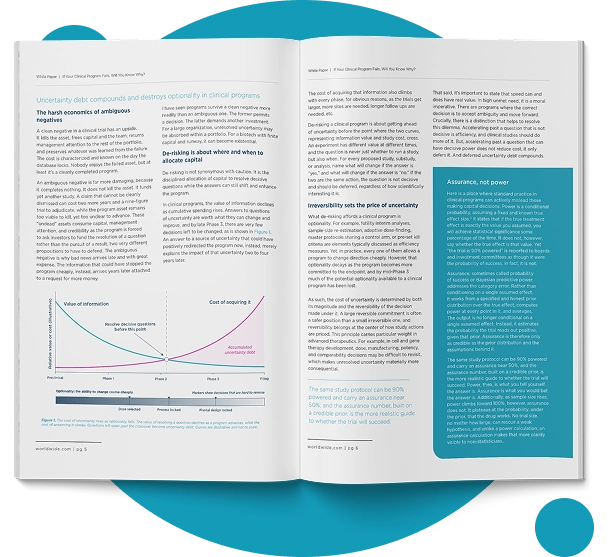
Information loses value as spending rises. By late Phase III, an answer that could have redirected the program can only explain what went wrong.
Clinical Trial Success Rates and Termination Causes
6.7 %
Likelihood of approval from Phase I in 2014–2023, down from 10.4% in 2003–2011
34 %
Share of Phase II/III trial terminations driven by strategic and business decisions (2013–2023)
25 %
Share of those terminations driven by efficacy
By Modality
The same open question costs more when you can't re-dose, remanufacture or reverse. With small molecules, waiting until Phase III to answer a question can be a reasonable trade. In cell and gene therapy, that option rarely exists, and acting as if it does can be expensive. The paper maps how the main source of uncertainty changes across five modalities.
Closing Questions
Before your next decision point, ask:
- What uncertainties remain?
- Which are avoidable?
- If the next study fails, will we know why?
About the Author
Panteli Theocharous, PhD, FRCPath
Chief Therapeutics & Clinical Strategy Officer and President of Europe, Worldwide Clinical Trials
Dr. Theocharous has spent more than 35 years in leadership roles across CROs, pharma and venture-backed biotech, so he has seen development decisions from both sides of the table. He served as CEO of VectorGen and as CMO at several biotech companies. At PPD, he was Global Biopharma Chief Medical Officer and founded and chaired the company's Cell & Gene Therapy Institute. As a biotech entrepreneur and board advisor, he knows what it takes to raise capital and defend a program to investors. His clinical career began in stem cell transplantation, and his work spans hematology, oncology, rare disease and cell and gene therapy. He holds a PhD in Clinical Cancer Medicine from the UCL Cancer Institute.

Facing a major decision point?
Talk with a Worldwide expert to find the open questions in your program and resolve them before they become costly